

An intensive Arabic course compresses what normally takes 3–4 years into 6–12 months of focused, daily learning. It works — but only for the right person, with the right structure, and a clear goal. This guide covers everything: what intensive Arabic actually looks like, how it compares to regular courses, what a full 1-year track achieves, and how to reach advanced fluency from any starting point.
Who Is This For?
Let’s be direct. Intensive courses aren’t for everyone. I’ve watched too many people sign up for something that wasn’t right for them, struggle through it, and then blame the program. It wasn’t the program. It was the mismatch.
This is for you if:
- You have a real deadline — moving to an Arabic-speaking country, a job requiring Arabic proficiency, an upcoming opportunity with a specific date. Not a vague “someday.” An actual date.
- You thrive under structure and pressure. You’re someone who gets more done with clear expectations and daily accountability than with open-ended flexibility.
- You can commit 2–6 hours daily to focused Arabic study. Not on the side. Not squeezed between a full-time job and a packed schedule. Real, dedicated time.
- You’re willing to be uncomfortable. Making mistakes in front of native speakers. Forgetting words mid-sentence. Feeling like you’re not progressing — and pushing through anyway.
- You want results in months, not years.
This is NOT for you if:
- You’re learning Arabic purely for cultural interest with no specific goal or deadline. A regular course will be more enjoyable and just as effective for you.
- You can only realistically commit 1–2 hours per week. That’s not intensive — that’s regular paced, and there’s nothing wrong with that.
- You prefer self-directed learning where you choose your own materials, pace, and schedule. Intensive courses are the opposite of that.
Know which category you’re in before you commit. It saves you time, money, and frustration.
What Intensive Arabic Actually Looks Like Day to Day

Here’s the real version — not the marketing version.
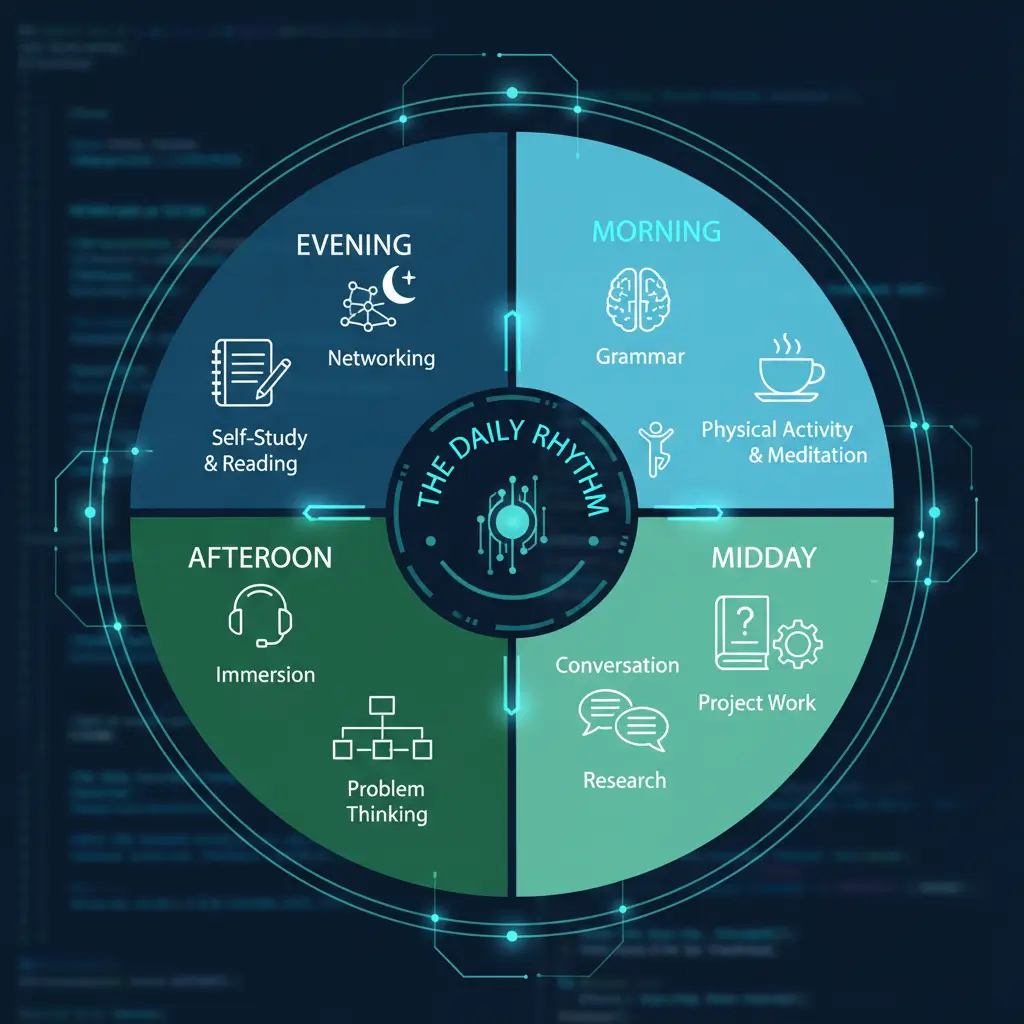
Morning: Active Learning (2 Hours)
You start tired. That’s normal. The teacher isn’t standing at a whiteboard lecturing while you take notes. They’re in conversation with you. They tell a story in Arabic. You listen. They ask you questions about the story. You have to retrieve vocabulary, construct sentences, and communicate meaning — all in real time.
Vocabulary comes up in context. Food words when you’re discussing meals. Travel words when you’re planning a trip. Business terms when you’re role-playing a meeting. Your brain connects words to context, which is why they stick. This is fundamentally different from memorizing a word list.
By the end of the morning session, your brain feels tired. That’s not failure. That’s evidence of real work.
Mid-Morning: Speaking Practice (2 Hours)
A native speaker asks you about yourself. Your background. Your goals. Your life. You have to think on your feet. You don’t have time to translate in your head. You just speak.
You make mistakes. You forget words. You construct sentences awkwardly. And then the native speaker corrects you — specifically, showing you a better way to say it. You hear the correct version. Your brain registers it. You move on.
Real scenarios. A job interview. Negotiating a price. Booking a hotel room. Handling a complaint. These aren’t artificial textbook exercises. They’re things you might actually need to do. Because they’re realistic, your brain takes them seriously.
This is where the fear of speaking starts to dissolve. Week one: terrifying. Week two: nervous but adapting. Week three: something shifts. Week four: actual conversations. That progression is reliable — but only if you’re in the sessions consistently.
Afternoon: Cultural Immersion (1–2 Hours)
This is what separates intensive courses from traditional classes. And it’s often underestimated.
Watching an Arabic film and discussing it. Not just understanding the words — understanding the cultural references, the humor, the way people interact. Reading Arabic news and discussing current events. Cooking traditional food while learning food vocabulary. Guest speakers from Arabic-speaking countries sharing their perspectives.
Language without culture is just sounds and vocabulary. Culture gives language meaning. It explains why Arabs say things the way they do. It shows you the values and assumptions behind the expressions. Students who skip this layer end up with technically correct Arabic that sounds robotic and foreign to native speakers.
Evening: Self-Study (30–60 Minutes)
This is where many students struggle. After a full day of intensive learning, more studying feels impossible. But this is where your brain consolidates what it learned. This is where information moves from short-term to long-term memory.
Review vocabulary from today. Write three sentences using new grammar points. Listen to Arabic audio on a topic you covered. The homework isn’t busywork. It’s strategic reinforcement. Students who do it consistently progress 2–3 times faster than those who only show up to sessions.
The 1-Year Intensive Arabic Course: What’s Actually Achievable

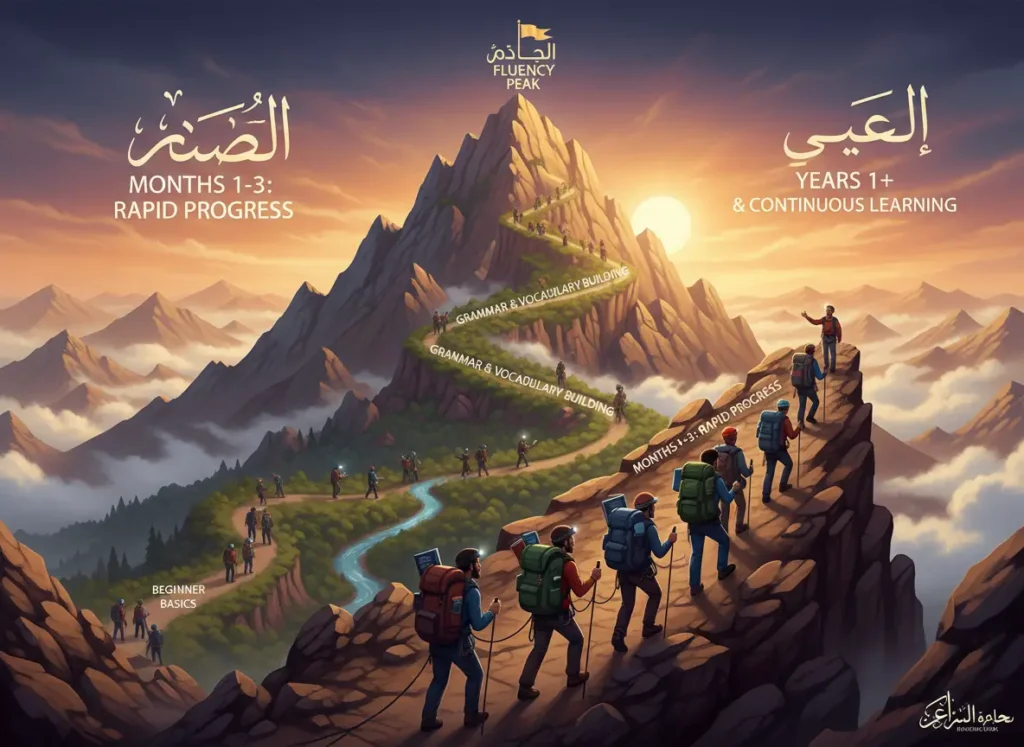
A full year of intensive Arabic — done properly — produces results that genuinely surprise people who’ve only seen what regular courses achieve. Here’s an honest breakdown of what’s realistic at each stage.
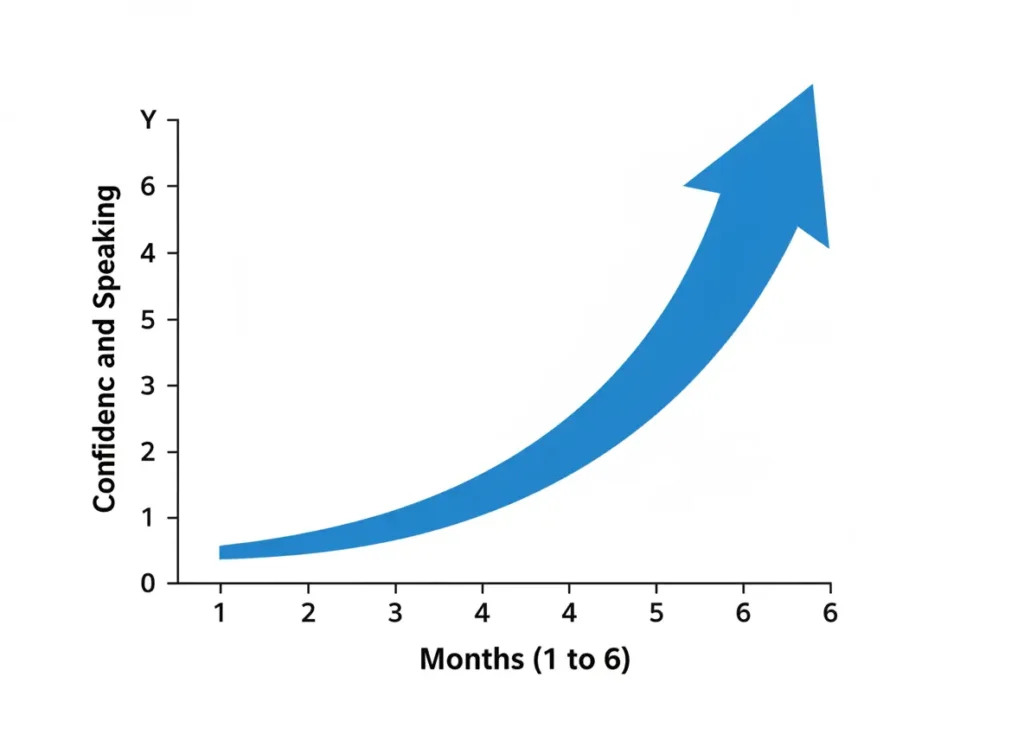
Months 1–2: Foundation
You learn the Arabic alphabet. You can read basic words aloud. You understand greetings, numbers, simple questions. You’re starting to recognize letter patterns and common root words.
This phase feels slow. It isn’t. You’re building the infrastructure everything else runs on. Students who rush through this phase almost always have to come back to it later.
Months 3–4: Basic Conversation
Short conversations are possible. You can introduce yourself, ask basic questions, understand slow clear speech from a native speaker. You’re starting to recognize verb patterns. 300–500 words active in your vocabulary.
You’re not fluent. But you’re functional. And functional feels incredible after just four months.
Months 5–6: Real Communication
Real conversations on familiar topics. Independent reading of short texts. 500–800 words. Tajweed basics if Quranic Arabic is part of your goal. You can handle simple situations — shopping, directions, introductions — without panicking.
This is the milestone most people think takes years. With intensive daily study, it’s month six.
Months 7–9: Intermediate Fluency
Conversations on most everyday topics. Reading Arabic news with reasonable comprehension. 800–1,200 words. Beginning to think in Arabic without translating. Grammar starting to feel intuitive rather than mechanical.
This is also the hardest phase emotionally. The initial excitement has faded. Progress feels slower than it was. Most dropouts happen here. The students who push through this valley are the ones who reach real fluency.
Months 10–12: Advanced Foundation
Conversational fluency. Reading longer texts. Writing coherent paragraphs. Understanding Arabic media at a functional level. 1,200–1,500+ words. Beginning to appreciate nuance — why certain words were chosen over others, how register shifts meaning.
After 12 months of genuine intensive study, you’re not a native speaker. But you’re someone who can function, communicate, and continue improving independently. That’s the real goal.
For a detailed look at what a structured 1-year Arabic course covers at each level, including Classical Arabic grammar and formal academic tracks, Alphabet Arabic Academy offers year-long programs specifically designed for this progression.
Speaking: The Thing That Actually Changes You
I’ve taught hundreds of students. The ones who improve fastest aren’t the ones who study grammar hardest. They’re not the ones who memorize the most vocabulary.
They’re the ones who speak the most.
Speaking is terrifying. You don’t want to sound stupid. You don’t want to make mistakes in front of other people. You’re worried about your accent, about forgetting words, about looking foolish.
Here’s what I’ve learned after years of watching this pattern: you have to sound stupid before you sound good. There’s no shortcut around that phase.
In an intensive course, you speak constantly. Multiple times every day. You’re not waiting for your turn in a class of 30 students. You speak in sessions, with native speakers, with classmates, in role-plays, in real situations.
The first week, you’re terrified. You stumble over words. You forget basic vocabulary. You feel embarrassed. This is normal.
By week two, you’re still nervous, but you’re adapting. Fewer mistakes. Faster retrieval. Starting to anticipate what you need to say.
By week three, something shifts. You stop thinking about the grammar rules. You stop translating in your head. You just speak. It’s not perfect — but it’s real communication.
By week four, you’re having actual conversations. With real people. About real topics. And you realize that native speakers understand you. They appreciate your effort. They help you improve. You’re not being judged. You’re being supported.
This is what intensive courses give you that regular classes often can’t: enough speaking volume to get through the fear and out the other side.
Immersion: How to Make Arabic Your Default Mode

Real immersion means Arabic becomes your default language for several hours every day. Your brain doesn’t have the luxury of retreating to English when things get hard.
This adaptation is what creates fluency. Not just studying Arabic. Living Arabic.
In the classroom: Everything happens in Arabic. The teacher uses English minimally — only when absolutely necessary to prevent a complete breakdown in understanding. At first this is frustrating. You want them to explain things in English. But then something shifts. Your brain adapts. You start understanding more. You start thinking in Arabic.
With native speakers: Not just teachers. Native speakers from the community. Other international students. You make friends. You study together. You practice outside of class. This social layer of immersion is powerful — you’re not just learning a language, you’re building relationships in it.
Through media: Arabic films, music, news, social media. Your brain processes authentic Arabic all day long. Not textbook Arabic. The Arabic that native speakers actually use. This gap — between formal learning and real-world language — closes faster when you’re consuming authentic content daily.
Through culture: The food, history, traditions, the context behind expressions. Language makes so much more sense when you understand the culture it grew in. Students who engage with this layer consistently report that vocabulary sticks differently — not just as words, but as concepts with meaning attached.
Advanced Arabic: What It Takes to Get There

Intensive courses get you to conversational fluency. But what if your goal is higher than that? What if you need professional-level Arabic — for academic research, for advanced business contexts, for understanding classical texts or the Quran deeply?
That’s where advanced Arabic training comes in. And it’s a different kind of work.
What “Advanced” Actually Means
Reaching B2 (upper intermediate) is achievable in 6–12 months of intensive study. That’s the level where you can hold fluent conversations, read Arabic news, and function professionally.
Reaching C1–C2 (advanced to near-native) typically requires 18–36 months of continued study beyond that. The U.S. Foreign Service Institute estimates 2,200+ hours to full professional fluency for English speakers. That’s not discouraging — it’s just honest about the timeline.
What Advanced Courses Focus On
Classical vs. Modern Standard Arabic. Many advanced learners discover they need both — MSA for professional and contemporary contexts, classical Arabic for religious texts, literature, and historical sources. These overlap significantly but have meaningful differences.
Rhetoric and register. Advanced Arabic isn’t just more vocabulary. It’s knowing when formal Arabic versus colloquial Arabic is appropriate. It’s understanding how regional dialects interact with MSA. It’s recognizing literary devices, metaphor, and the nuance that separates competent Arabic from genuinely fluent Arabic.
Academic and professional vocabulary. Business Arabic, legal Arabic, medical Arabic, diplomatic Arabic — each field has specialized vocabulary that generic courses don’t cover. Advanced learners targeting these fields need specialized instruction.
Authentic texts. Advanced courses work with real Arabic media, literature, and historical documents — not adapted texts designed for learners. Reading the Arabic that native speakers actually produce is what closes the gap between textbook knowledge and real fluency.
For learners ready to move from intermediate to genuinely advanced, the advanced Arabic course at Alphabet Arabic Academy covers all of this — refined grammar, advanced writing, oral fluency, cultural depth, and exposure to Arabic in media and literature.
Full Arabic Course: From A to Z
Whether you’re starting from absolute zero or picking up from an intermediate level, understanding what a complete Arabic curriculum covers helps you know where you are and where you’re heading.
Level 1 — Absolute Beginner
Arabic alphabet and pronunciation. Reading simple words. Basic greetings, numbers 1–20, core survival phrases. Introduction to sentence structure (subject, verb, object). Timeline: 4–8 weeks with daily practice.
Level 2 — Beginner
Reading short texts. Building vocabulary to 300+ words. Basic verb conjugation (past tense). Simple conversations about yourself, your family, your daily routine. Introduction to masculine/feminine forms. Timeline: 2–3 months.
Level 3 — Elementary
Reading and writing simple paragraphs. 500+ vocabulary words. Present and future verb tenses. Ability to ask and answer questions on familiar topics. Beginning work on noun cases. Timeline: 3–4 months.
Level 4 — Intermediate
Complex reading comprehension. 800+ words. Full verb system including irregular verbs and verbal nouns. Conversation on most everyday topics without significant difficulty. Beginning formal writing. Timeline: 4–6 months.
Level 5 — Upper Intermediate (B2)
Reading Arabic news and literature. 1,200+ words. Sophisticated grammar — relative clauses, conditional sentences, passive constructions. Comfortable in professional conversations. Writing formal reports or essays. Timeline: 4–6 months.
Level 6 — Advanced (C1)
Reading classical texts. 2,000+ words. Full grammar mastery including case endings and classical structures. Discussing complex topics in depth. Writing at an academic level. Dialect understanding alongside MSA. Timeline: 6–12 months.
Level 7 — Proficiency (C2)
Near-native reading and listening comprehension. Following rapid native speech. Appreciating literary Arabic, humor, and cultural references. This level requires ongoing immersion — Arabic media, conversation with natives, reading Arabic for pleasure. Timeline: ongoing.
Most serious learners reach B2 (Level 5) within 12–18 months of dedicated study. C1 typically takes 24–30 months. C2 is a lifelong project — but a deeply rewarding one.
Intensive vs. Regular Courses: The Honest Comparison
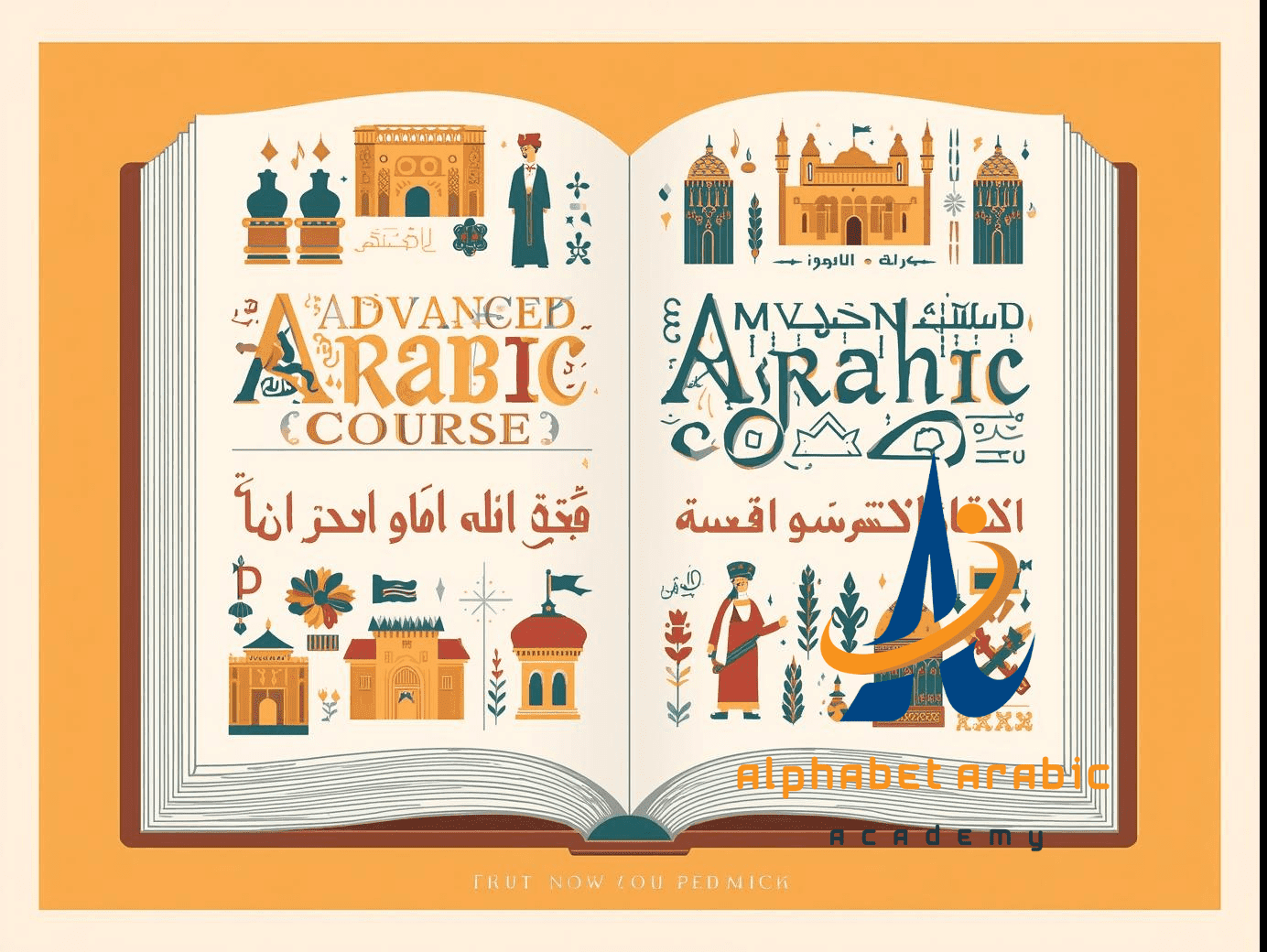
I get asked this constantly. Which is better: intensive or regular?
Honestly? It depends on your life. Not on what sounds more impressive.
| Factor | Intensive Course | Regular Course |
|---|---|---|
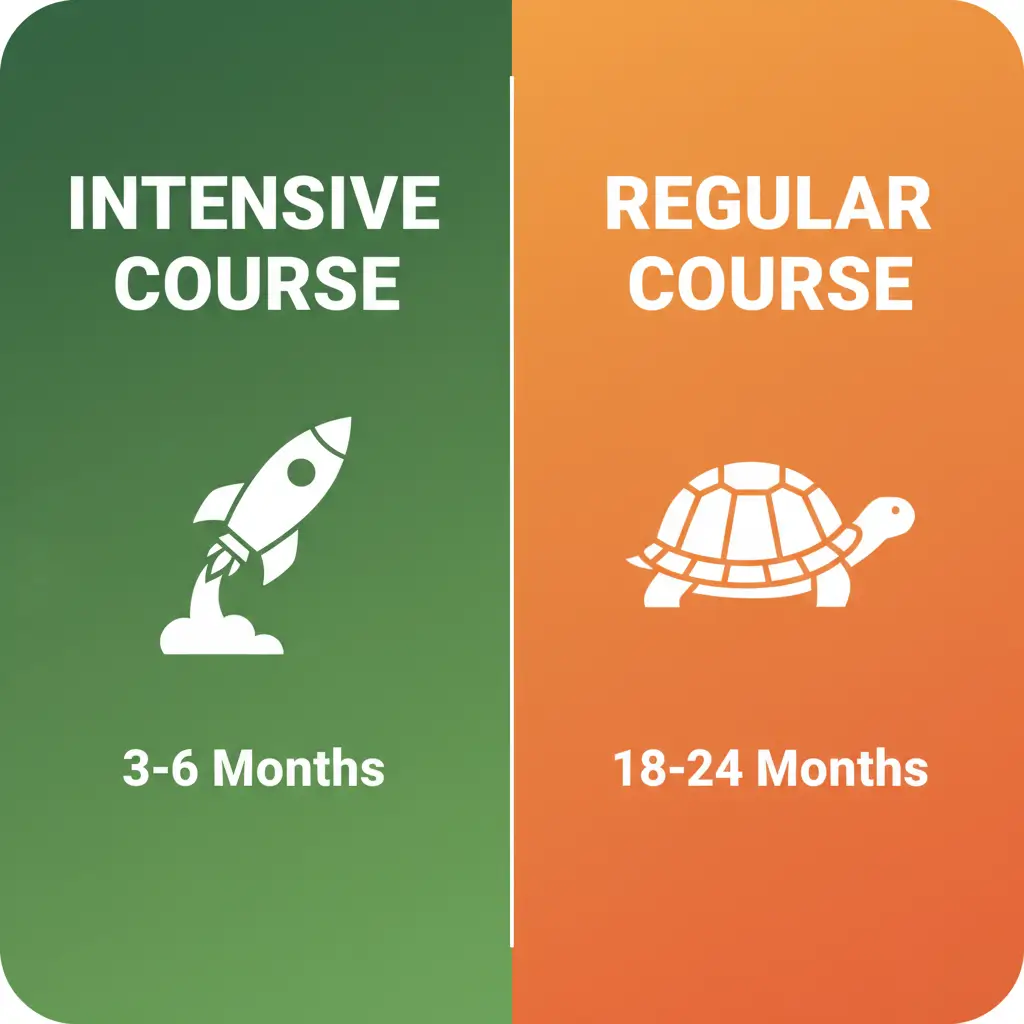
| Time to conversational fluency | 6–12 months | 18–36 months |
| Daily time commitment | 2–6 hours | 30–90 minutes |
| Speaking practice | Multiple hours daily | 30–60 min/week |
| Immersion level | Very high | Moderate |
| Cost (monthly) | Higher | Lower |
| Stress level | High | Manageable |
| Best for | Clear deadline, full commitment | Sustainable long-term learning |
| Can work alongside full-time job? | Difficult | Yes |
The numbers tell the story. Intensive compresses time. Regular is sustainable.
Neither is inherently better. Choose based on your actual life situation — not on what sounds more committed or impressive to say out loud.
If you have a job, a family, and normal life commitments, a well-designed regular course with consistent daily practice will get you to fluency. It’ll just take longer. That’s okay. Progress that fits your life is infinitely better than an intensive course you quit after three weeks because it wasn’t sustainable.
If you have a real deadline, can genuinely block out the time, and are mentally ready for the intensity — go intensive. You’ll compress years into months. But only if you actually do the work.
Common Mistakes in Intensive Arabic Learning
I’ve watched hundreds of students go through intensive programs. The failures follow predictable patterns.
Choosing intensive when regular was the right fit. Signing up because it sounds more serious, then struggling to keep up with a commitment you weren’t actually ready for. Be honest about your availability before you register, not after.
Underestimating the mental fatigue. By week two or three, you’re genuinely exhausted. This is normal — your brain is processing new sounds, grammar patterns, and vocabulary for hours every day. Students who haven’t been warned about this sometimes interpret it as a sign they’re failing. It’s a sign they’re working.
Speaking only when forced to. Waiting for the teacher to call on you instead of volunteering. Role-playing scripts instead of improvising. Practicing only with classmates instead of seeking out native speakers. Speaking volume is the single biggest predictor of how quickly your fluency develops.
Skipping the evening review. After a full day of learning, the last thing you want is more Arabic. But this is where your brain consolidates. Short-term memory becomes long-term memory during rest and review. Skip the review consistently and you’ll feel like you’re not retaining anything — because you’re not.
Expecting linear progress. Fluency doesn’t grow in a straight line. There are plateaus. There are weeks where nothing seems to be working. There are breakthroughs that come suddenly after what felt like stagnation. Students who know this push through the plateaus. Students who don’t often quit right before the breakthrough.
Treating grammar as the goal. Grammar is a tool for communication, not the destination. Students who spend their sessions obsessing over case endings often speak worse than students who’ve internalized patterns through conversation practice. Learn grammar through usage. Understand patterns through repetition. The rules become clear through experience, not through memorization.
Ignoring the culture layer. Arabic has a cultural context that’s inseparable from the language. Students who skip cultural content — films, music, conversations about daily life — end up with technically correct Arabic that sounds foreign and unnatural to native speakers.
The Challenges You’ll Face (And How to Get Through Them)
Intensive courses are hard. Anyone who tells you otherwise is selling something. But knowing the challenges in advance means you’re not blindsided by them.
Mental fatigue in weeks 2–3. Your brain is working at maximum capacity. Students consistently report feeling more mentally tired than they’ve ever been. This is temporary. By weeks 4–5, your brain becomes more efficient at processing Arabic. The fatigue decreases. Hold on.
Motivation dip in weeks 3–4. Initial excitement fades. The novelty wears off. You’re tired. Progress feels slower. You question whether you made a huge mistake. This is the trough that separates students who reach fluency from those who don’t. The breakthrough is on the other side of this trough. Push through.
Pronunciation frustration. Arabic sounds challenging for English speakers. The emphatic consonants. The guttural sounds. The different rhythm. These feel unnatural at first. But here’s what’s actually true: perfect pronunciation isn’t required for communication. Native speakers understand you even with an accent. And your accent genuinely improves with practice — a lot of practice.
Grammar overwhelm. The verb system. Case endings. Gender agreement. Broken plurals. It’s a lot to absorb quickly. But you don’t need to master grammar perfectly before you can communicate. You learn grammar through usage. You understand rules through repetition before you understand them intellectually.
What I’ve Learned from Students Who Succeeded
Let me tell you about Omar.
He was 34 years old. A civil engineer from Canada. He’d been studying Arabic on and off for three years — apps, books, YouTube. He knew hundreds of words. He understood grammar rules. But when he had to speak? He froze. Every time.
He told me: “I’m tired of knowing Arabic but not speaking it.”
So we put him in an intensive track. Five sessions a week. Two hours daily. Plus homework. Plus speaking practice with native Egyptians.
The first two weeks were brutal. He was exhausted. He wanted to quit. Every single day.
But he didn’t.
By week four, he was having basic conversations. By month three, he led a meeting in Arabic without switching to English. His colleagues were shocked.
By month six, he travelled to Cairo for a project. He called me from a coffee shop. “I just spent 45 minutes talking to the waiter — in Arabic. About football. About Egyptian food. About nothing and everything.”
“Three years of regular learning didn’t do what six months of intensive did,” he said.
That’s the difference. Not talent. Intensity. Consistency. And refusing to quit when it got hard.
After watching hundreds of adults go through intensive programs, the ones who succeed share certain patterns. Not natural talent. Not exceptional memory. Specific habits and mindsets.
They have a concrete reason why. Not “I want to speak Arabic.” But “I’m relocating to Cairo in six months” or “I got a job offer that requires Arabic proficiency by March.” A real reason gives you something to return to when things are hard.
They’re comfortable with discomfort. Making mistakes in front of others. Feeling embarrassed. Forgetting vocabulary at exactly the wrong moment. The students who succeed see this as the process, not as evidence of failure.
They show up every single day. Even when they’re tired. Even when they’re frustrated. Even when they want to quit. Consistency beats talent every time in language learning.
They engage with the culture, not just the language. Arabic films, music, news, conversations about daily life in Arabic-speaking countries. This engagement accelerates vocabulary retention and makes the language feel alive rather than academic.
They build a community around their learning. Friends in the program. Native speakers they’ve connected with. Other learners online. Language learning in isolation is harder and lonelier than it needs to be.
Frequently Asked Questions
Q1: How long does it take to become conversational with an intensive course?
In a well-designed intensive program with 2–6 hours daily, basic conversations are possible by month two. Complex conversations by month four. Functional conversational fluency by month six. Advanced fluency takes 12–18 months of continued dedicated study.
Q2: Can I work full-time while doing an intensive Arabic course?
Realistically, no. Intensive courses require 2–6 hours daily of focused study. Adding full-time work means compromising both. Most students either take a leave of absence, study during a career break, or choose a structured regular course that fits around work commitments.
Q3: What if I start intensive and fall behind?
Talk to your instructor immediately — don’t wait. Most programs offer additional support or tutoring. Falling behind happens. The key is addressing it quickly rather than letting it compound. Silence is the worst response to struggling.
Q4: Are online intensive courses as effective as in-person?
Online intensive courses can be highly effective, especially with qualified native teachers, live sessions, and structured curriculum. You lose the full cultural immersion of being physically in an Arabic-speaking country. But you gain flexibility, access to better teachers globally, and significantly lower cost. For most learners, online intensive is the practical right answer.
Q5: Which dialect should I study intensively?
Most intensive courses teach Modern Standard Arabic (MSA/Fusha) as the foundation — it’s understood across all Arab countries and covers formal communication, reading, and writing. Egyptian colloquial Arabic is the most widely understood spoken dialect and an excellent second track. The right sequence: MSA foundation first, Egyptian Arabic alongside or after.
Q6: How do I know if I’m ready for an intensive course?
You’re ready if: you have a concrete goal with a real deadline, you can genuinely commit 2+ hours daily, and you’re willing to be uncomfortable and make mistakes consistently. You’re not ready if: you’re learning for casual interest, have limited time, or need everything to feel manageable and easy.
Q7: What’s the difference between intensive and a full Arabic course?
A full Arabic course covers all levels from beginner to advanced — it’s a complete curriculum. An intensive course is about the pace and time commitment at whatever level you’re at. You can do a full Arabic course intensively, or you can do it at a regular pace. They’re different dimensions of the same learning.
How Alphabet Arabic Academy Approaches Intensive Learning
At Alphabet Arabic Academy, we’ve built intensive and structured programs specifically for non-native speakers — from absolute beginners to advanced learners targeting professional fluency.
All teachers are native Egyptian Arabic speakers, many of them Al-Azhar University graduates. They don’t just know Arabic — they know how to teach it to people who didn’t grow up with it. That distinction matters more than most learners realize.
We offer flexible intensity levels. An extremely intensive track with 5 sessions per week for rapid progress. Regular intensive options at 3–4 sessions per week. And regular paced programs for learners who need sustainability over speed. You choose what fits your life and goals.
Online delivery via live sessions — not pre-recorded videos. Real-time interaction, immediate correction, and human feedback in every lesson. Classes available 7 days a week across all time zones.
Specialized tracks for Quranic Arabic and Tajweed, Egyptian conversational Arabic, Modern Standard Arabic, business Arabic, and Arabic for children. Your intensive program follows a curriculum matched to your specific goal — not a generic syllabus.
Pricing starting from $40/session, with course options for all levels and intensive tracks available here.
We have 5,000+ students from 80 countries and a 4.9/5 rating on Trustpilot. Those numbers come from real people who started where you are now.
Your Next Steps
Intensive Arabic courses aren’t for everyone. But if you have a clear goal, can commit the time, and are willing to push through the hard weeks — this approach transforms what’s possible. Months, not years.
Here’s what to do next.
Step 1: Know your starting point. Take the free Arabic placement test — it takes five minutes and tells you exactly which level to enter at. Don’t guess. Know.
Step 2: Define your specific goal. Write one sentence: “I want to [specific skill] by [specific date].” That sentence is your compass when motivation drops.
Step 3: Choose your intensity level honestly. Can you commit 2+ hours daily? 4+ hours? Or does 30–60 minutes daily with a regular paced course actually fit your life better? Choose based on reality, not ambition.
Step 4: Take a trial session. Experience live teaching from a native Egyptian teacher before committing to a package. You’ll know within one session whether the method, the teacher, and the pace are right for you.
Step 5: Commit fully for 90 days. Three months is when the results become undeniable. Don’t evaluate before then.
For a full overview of all Arabic course levels and learning paths — from complete beginner to advanced — the definitive guide to learning Arabic for adults covers every option and how to choose between them.
👉 Start your free placement test and find your entry point today.
Alphabet Arabic Academy — 5,000+ students from 80 countries, Al-Azhar certified teachers, 4.9/5 on Trustpilot. Based in Cairo, Egypt.